

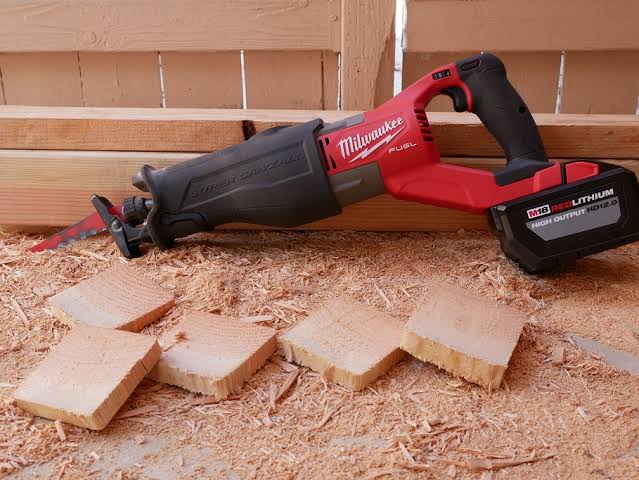
Versatility defines value in professional tools. A tool that performs one task with excellence is useful. A tool that performs across multiple trades, materials, and working environments becomes essential. The reciprocating saw falls firmly in the second category, and the range of industries that rely on it daily reflects both its adaptability and the depth of engineering behind its simple mechanism.
This article examines how reciprocating saws function across three major professional trades—construction, plumbing, and electrical—and what considerations matter most in each context.
Construction Applications: Demolition, Framing, and Renovation
Construction professionals encounter the widest range of material types, structural configurations, and cutting requirements of any trade. Reciprocating saws address this variety better than almost any other portable cutting tool.
In demolition work, the saw’s ability to cut through assembled structural components—framing timber, drywall, subflooring, and sheathing—often while embedded fasteners are still present, makes it the dominant tool for material removal. Demolition blades handle the combination of wood and metal without blade changes, accelerating the teardown process significantly.
Framing applications benefit from the saw’s ability to cut in tight configurations—between studs, at floor level, or overhead—where circular saws cannot operate safely or practically. Door and window rough openings are commonly adjusted using reciprocating saws once framing is complete.
Renovation work introduces the additional challenge of cutting precisely enough to preserve adjacent materials. A skilled operator using the right blade and speed setting can cut through a single layer of flooring without damaging the substrate beneath. This level of control separates the reciprocating saw from more aggressive demolition tools.
Plumbing Applications: Pipe Cutting Across Multiple Material Types
Plumbing is among the most demanding applications for reciprocating saws, primarily because the material types involved—copper, cast iron, galvanized steel, PVC, and CPVC—each require different blade specifications and cutting techniques.
Copper pipe, common in residential water supply systems, responds well to bi-metal blades at controlled speeds. The relatively soft material cuts quickly, but heat management remains important for maintaining clean edges that will receive fittings or solder connections.
Cast iron drain systems—found in older buildings and commercial construction—represent one of the more challenging cutting tasks in plumbing. Cast iron is brittle and hard, requiring diamond-grit or carbide-tipped blades that grind rather than shear through the material. Patience and consistent speed matter more than force in this application.
PVC and CPVC pipe, used extensively in modern residential and commercial drain-waste-vent systems, cut cleanly with medium-TPI blades at moderate speed. The priority is avoiding heat buildup, which causes edge melting that compromises fitting connections and pressure ratings.
Working in confined spaces—under sinks, in crawl spaces, and within wall cavities—is a routine part of plumbing work. Compact reciprocating saw designs that reduce the overall footprint of the tool without sacrificing motor power have made a significant difference to how efficiently plumbers operate in these environments.
Electrical Applications: Conduit, Cable Tray, and Access Cutting
Electricians use reciprocating saws primarily for two purposes: cutting metal conduit and creating access openings in walls, ceilings, and floors for cable routing.
Metal conduit—electrical metallic tubing (EMT), rigid metal conduit (RMC), and intermediate metal conduit (IMC)—requires clean, burr-free cuts to accept fittings correctly. A blade with an appropriate TPI for the conduit wall thickness produces cuts that require minimal deburring before assembly.
Access cutting for cable routing involves cutting through a combination of wall covering materials—typically drywall combined with wood studs or metal framing. This multi-material cutting scenario benefits from versatile blades capable of handling both materials without changing blades between cuts.
For work in energized environments—where accidental contact with live conductors is possible—selecting a saw with a non-conductive housing and maintaining awareness of blade exposure at all times are fundamental safety practices. While the tool itself doesn’t eliminate electrical risk, proper technique and blade management reduce exposure significantly.
Overhead and Inverted Cutting: Managing Weight and Fatigue
Many professional applications require cutting overhead or in inverted positions—situations where tool weight directly affects safety and accuracy. A heavy saw held above head height fatigues the operator quickly, leading to reduced control and increased risk of injury.
Manufacturers have addressed this through lightweight motor designs, compact battery integration in cordless models, and balanced weight distribution that reduces the perceived heaviness during overhead work. A saw that feels manageable at bench height may feel dramatically different after sustained overhead use.
Grip configuration also plays a role. Barrel-grip designs suit overhead and horizontal cutting where the operator needs maximum wrist flexibility. D-handle configurations provide better leverage for downward cuts and general-purpose use. Some professionals maintain both configurations for different task types.
Multi-Trade Professionals: Maximizing One Tool Across Applications
General contractors, remodelers, and multi-trade professionals who work across construction, plumbing, and electrical tasks simultaneously gain the most from a single high-quality reciprocating saw. The key to maximizing one tool across all applications lies in blade inventory management.
Maintaining a well-organized blade selection—sorted by material type and TPI—eliminates the delay of searching for the right blade mid-task. A blade roll or organized case with clearly labeled compartments for wood, metal, and PVC blades converts what could be a time-consuming selection process into a quick swap.
Understanding the crossover capabilities of multi-material blades also adds flexibility. These blades sacrifice some optimization for specific materials in exchange for acceptable performance across several types—a practical compromise for situations where material types shift rapidly.
The Professional Standard for Reciprocating Saw Use
Consistent professional results from a reciprocating saw come from combining the right tool with the right blade, the right speed setting, and technique appropriate to the material and application. No single variable alone determines outcome.
Professionals who invest time in understanding blade specifications, speed management, and the specific demands of each material type they work with will consistently outperform those who rely on one blade and full-speed operation across every task. The tool rewards knowledge and rewards it repeatedly—across every trade and every job site.